Learning Libyan Arabic with Cooking Shows

I have to admit I’ve been slacking when it comes to language learning and language learning posts in general, and my excuse is that politics and real life and work have been insane lately. And that stresses me out.
However, sometimes I remember what I intended to be doing with my free time: learning the Libyan dialect of Arabic, and working on Latin again.
I haven’t watched any new drama series or cartoons that had been uploaded for Ramadan this year. That’s a usual thing I look for, as these are good sources of spoken Libyan Arabic.
Since I am in the US, my access to a lot of written Arabic materials is limited, even in comparison to materials in German and French or Latin (which is technically “dead!”). So I rely a lot on YouTube, and I’m thankful to the modern internet for that. I couldn’t do this when learning German 26 years ago, for example, even if I could watch one hour of Deutsche Welle news per morning when staying at my parents’ house, because their cable had it for some reason. For one hour. At 4:00 AM.
So I went to the Libya Al-Ahrar YouTube channel a few days ago and watched some cooking shows. The format will be familiar to English-language viewers, but I don’t watch these much because they stress me out.
They’ll give you a lot of chances to listen to numbers (as the hosts count down the time contestants are given to chop up a /filfil har/ or similar), and of course, with food words. So far, I’ve seen one show where they made /shorba/, a very tasty Libyan soup with mint and chickpeas, among other things, and one where they made /ka’ek/ eggless cookies (biscuits, if you’re English) using the same wooden molds that I have.
Rather that typing this up again, here is an old graphic I made for a Latin-language video about bazin, because it lists a lot of the ingredients you’ll see on this show:
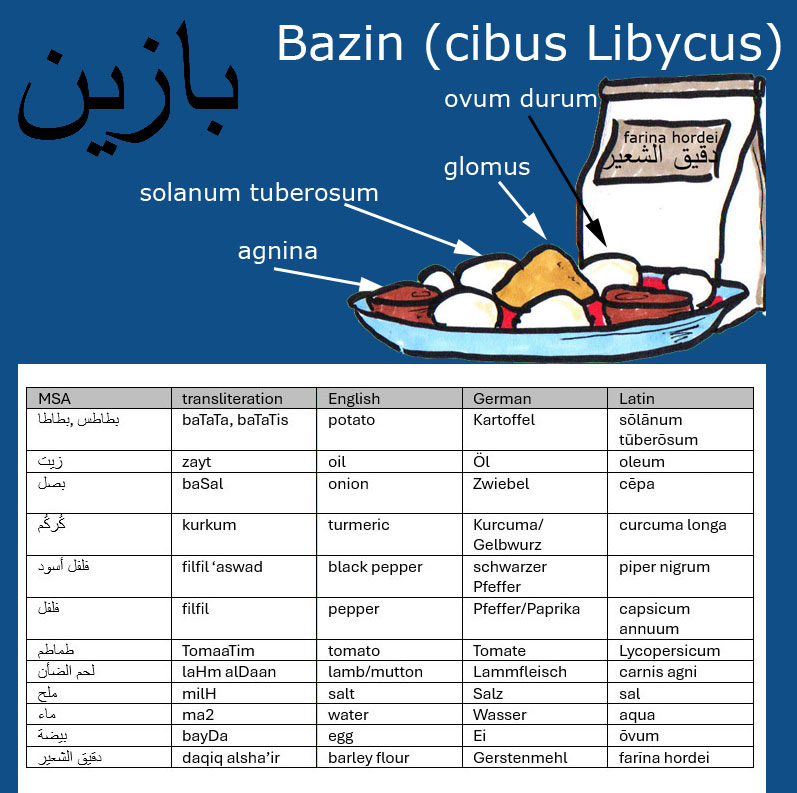
I notice that I forgot to add معجون طماطم /ma’jun TamaaTim/, tomato paste, which is a very important ingredient in Libyan cooking, as well. And that Libyans pronounce the word for water, ماء, more like /maya/ rather than an “ma” sound followed by a glottal stop. They often just say "/filfil har/ for hot chili peppers. I’ve seen Libyan expats, presumably in the US, making videos where they use Walmart’s Great Value brand beans and jalapeños in recipes, because that’s what they have available, but elsewhere they are using whatever hot peppers they feel like using.
Anyway, these types of competition shows stress me out a bit, with all the countdowns and running around and yelling. I would much rather look up recipes videos where some calm Libyan person speaks normally while pointing the camera at the stove, but this is definitely an option for getting more exposure to spoken Arabic, which some people might find appealing. I like cooking videos, I just don’t like the competitiveness. These have cute Lego-like animations of the contestants. I like Libya Al-Ahrar’s little Libyan guy 3d animated mascot, too.
عيلتنا أقوى is the name of the show, apparently comparing the strength of the families and their cooking skills. This also allows you to see the contestants introducing themselves, explaining things, making small talk, etc. though, which is also useful, and the hosts discussing what is good or bad about the foods. I haven’t watched them all yet, but they are on my “to watch” list for Libyan content.
I have always felt that this sort of content is preferable to just using quiz apps like DuoLingo, which work well as a supplement (and, crucially, for learning the Arabic alphabet!). My goal is always to watch content which was made by and for the people who speak the language in question, and I see so many people just do DuoLingo and not pay any mind to real-life content such as this, even in languages like Spanish or Italian, where there is all kinds of content out there, surely there is at least something people could find that interests them! And to use apps and textbooks to build up grammar and vocabulary alongside this.
So in this case, I would suggest getting some vocabulary as a list, to refer to, and then seeing that vocabulary being actively used in a cooking show such as this one. Or just search for the name of a recipe and watch more laid-back cooking videos, which is my preference!
Language learning is also a tool for building communication, understanding, and empathy, and is a reason some people are lacking in these things. And it can help to stave off neuro-degeneration.